

- Home
- News, Articles & Reviews
We are hiring! Please click here to join our growing magazine delivery team in Gloucestershire!
Areas
Pets & Wildlife
Archive

Creating rain garden sanctuaries
All Areas > Pets & Wildlife > Wildlife Matters
Author: Anna McQuillan, Posted: Tuesday, 24th March 2026, 09:00
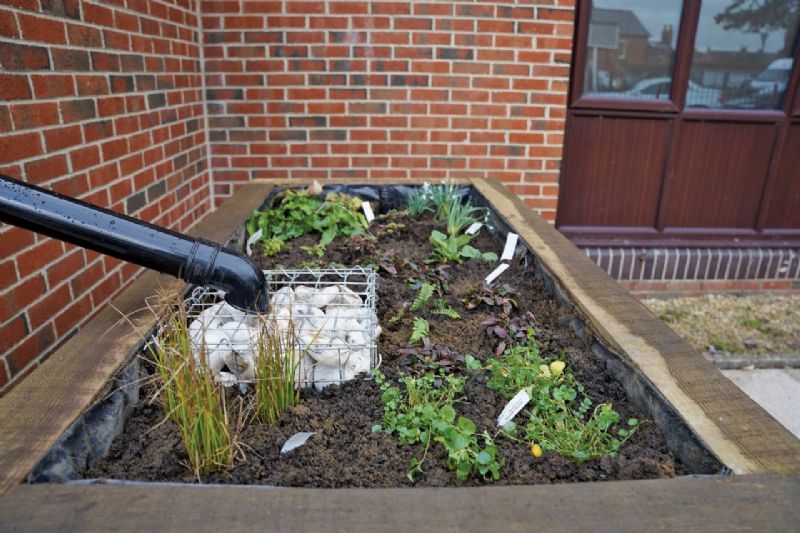 A rainwater garden community project by Tewkesbury Baptist Church. Image: Baazir Kaleelur Rahman
The weather is pretty good at raining here in Gloucestershire and this year it has really shown off, but as I write this article a few weeks in advance, I’m unsure whether we’ll be expecting the textbook April showers we’ve become accustomed to or, like last year, an unexpectedly early summer.
April 2025 brought only 56% of its expected rainfall. Perhaps not everyone will agree, but part of me hopes we get closer to a typical year, as missing rain is a subtle warning sign of climate tipping out of balance.
Flooding, meanwhile, is a familiar sight across our county. As our land becomes increasingly urbanised, rainwater races over hard surfaces instead of slowly permeating through soil. This speeds up the water cycle, increasing pressure on drainage systems and, eventually, our rivers, which creates conditions that make flooding more likely.
Creating miniature sanctuaries for wildlife
This brings me to my main topic, rain gardens. These little interventions mitigate flood risk while creating miniature sanctuaries for wildlife.
Rain gardens are shallow dips in the ground, or raised beds, filled with compost, sand and gravel, and topped with a palette of plants. They catch runoff from roofs and paved areas, letting it filter through naturally. This slows the surge into drain systems, filters pollutants from the water, and ultimately reduces flood risk.
Rain gardens are good spots for drawing in nature, something I always appreciate while walking in an urban landscape where the grey concrete becomes monotonous. Leafy, nectar-rich plants promote fast-forming ecosystems, attracting pollinators and detritivores (things like woodlice that eat decaying matter). Rain gardens stitch opportunities for nature back into our communities.
On my walking commute, I’m often in awe of how quickly a small patch can transform. Pollinators are often first to move in. Sturdy native plants such as purple loosestrife, knapweed or yarrow offer bees and butterflies vital nectar sources from early spring to late autumn, when food is often patchy in towns.
Proof that wildlife is always ready to return
Then succession really takes place: moss, fungi, nesting solitary bees I mentioned last month, or even the odd sheltering toad. These little pockets of life are proof that wildlife is always ready to return, even to those little spots.
I’d like to highlight two brilliant local examples. Gloucester Rugby Club has installed several rain gardens at Kingsholm Stadium, creating new wildlife stepping stones while easing the pressure on its drainage system. The club has used its platform to show the possibilities of integrating environmental initiatives, even on pitch-side.
A shared responsibility for local wildlife
Tewkesbury Baptist Church has also recently created a series of rain gardens with a group of volunteers; a testament to community spirit and shared responsibility for local wildlife.
When something like a rain garden is built, we can simultaneously tackle multiple challenges: flood risk, water pollution, green in urban spaces and giving room for wildlife. A small patch might not feel like much, but to the little creatures living alongside us it’s a lifeline, and a reminder that opportunities for nature are welcome in every corner of Gloucestershire.Anna McQuillan is a Research Master's zoology graduate. She is the founder of Hopefully: A Fundraiser for Wildlife, a non-profit company that organises fundraising events for wildlife. Outside of working she is still in pursuit of observing nature, be it wildlife photography or underwater while scuba diving. Her favourite UK animal is the kestrel.
Copyright © 2026 The Local Answer Limited.
Unauthorized use and/or duplication of this material without express and written permission from this site's author and/or owner is strictly prohibited. Excerpts and links may be used, provided that full and clear credit is given to The Local Answer Limited and thelocalanswer.co.uk with appropriate and specific direction to the original content.More articles you may be interested in...





© 2026 The Local Answer Limited - Registered in England and Wales - Company No. 06929408
Unit H, Churchill Industrial Estate, Churchill Road, Leckhampton, Cheltenham, GL53 7EG - VAT Registration No. 975613000You are leaving the TLA website...
You are now leaving the TLA website and are going to a website that is not operated by us. The Local Answer are not responsible for the content or availability of linked sites, and cannot accept liability if the linked site has been compromised and contains unsuitable images or other content. If you wish to proceed, please click the "Continue" button below: