

- Home
- News, Articles & Reviews
We are hiring! Please click here to join our growing magazine delivery team in Gloucestershire!
Areas
Pets & Wildlife
Archive

All is quiet... or is it?
All Areas > Pets & Wildlife > Wildlife Matters
Author: Anna McQuillan, Posted: Monday, 24th November 2025, 09:00
The nights are long, the trees are bare. Through the frost-layered quiet, the robin delivers a solo as he awaits his Christmas spotlight. But the rest of the earth does not lie as still as you may think.
Beneath our feet, a hidden world hums with life: scuttling, feasting, and thriving. We just can’t see it without a microscope. Within the soil, billions of organisms carry on their unnoticed existence.
One of the main characters in this tiny landscape is the nematode, also known as the roundworm. Scientifically, they are a big deal. Nematodes were the first organism to have their entire DNA decoded – like being the first to have their biological instructions fully read. The species in question, C. elegans, is the main organism scientists use to understand how ageing works in more complex animals.
Three billion nematodes per acre of soil
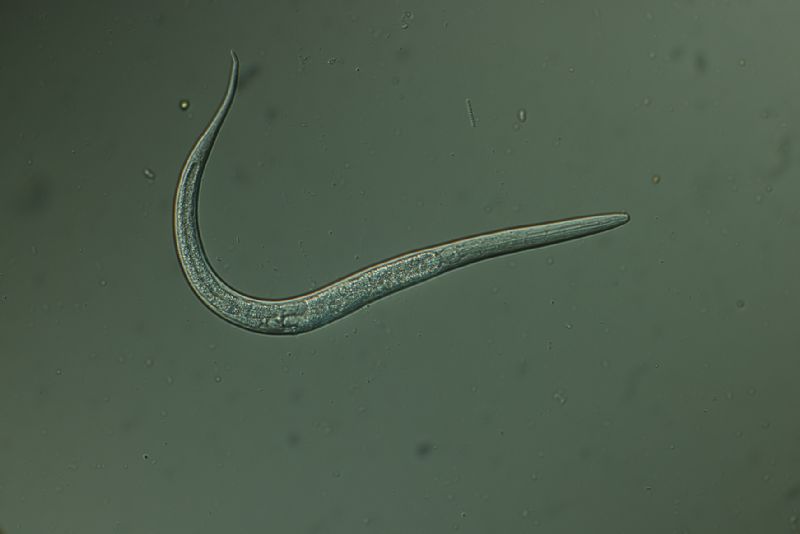
And they are everywhere. Up to three billion nematodes per acre have been found in the top layer of soil. If you were to magically remove the Earth but leave all its organisms in place, you’d still see a ghostly outline of the planet, due to the sheer number of nematodes. That was my university lab teacher’s favourite fact. He’s actually the one who captured the image shown here. Would I be writing about nematodes if he hadn’t been so wildly enthusiastic? Probably not.
Nematodes have a long, snake-like shape. They’re not the supermodels of the microscopic world, but their design is incredibly robust and effective. They’ve been found in every environment on Earth: from the deepest ocean trenches to the highest mountain peaks. In fact, a species was recently revived after being frozen in Siberian permafrost for 46,000 years. Clearly, they didn’t learn from Jurassic Park.
An optional genetic extra if the opportunity arises
They move in a curious way. One side of their body lifts, then the other, like a little wiggle dance. Honestly, it’s kind of cute to see it under a microscope. Like humans, they can reproduce with other individuals, but that’s more of an optional genetic extra if the opportunity presents itself. Mostly, nematodes don’t need a partner.
So, what’s the (ecological) point of them?
Nematodes play many roles. Due to being so widespread, they pop up in all sorts of food chains. Sometimes they are decomposers, breaking down organic matter, and other times they are helpful allies for crops (only if you’ve got the right kind).
A vast and diverse group
Writing about them this month has made me realise how hard it is to summarise a group so vast and diverse. It’s like trying to explain all mammals in one go, instead of just telling you about a hedgehog.
I’ll leave you with this: although nematodes are everywhere, they’re mostly harmless. Sure, a few parasitic types exist, but we’ve got our ways to deal with those. They’ve been living alongside us our whole lives and everything’s been mostly fine!Copyright © 2026 The Local Answer Limited.
Unauthorized use and/or duplication of this material without express and written permission from this site's author and/or owner is strictly prohibited. Excerpts and links may be used, provided that full and clear credit is given to The Local Answer Limited and thelocalanswer.co.uk with appropriate and specific direction to the original content.More articles you may be interested in...





© 2026 The Local Answer Limited - Registered in England and Wales - Company No. 06929408
Unit H, Churchill Industrial Estate, Churchill Road, Leckhampton, Cheltenham, GL53 7EG - VAT Registration No. 975613000You are leaving the TLA website...
You are now leaving the TLA website and are going to a website that is not operated by us. The Local Answer are not responsible for the content or availability of linked sites, and cannot accept liability if the linked site has been compromised and contains unsuitable images or other content. If you wish to proceed, please click the "Continue" button below: